Classical Chinese literature is a great treasure, with the “Four Great Classical Novels” at its peak. The first of the four is “Romance of the Three Kingdoms” by Luo Guanzhong. Beside its famous men such as Lü Bu, Guan Yu and Zhang Fei, there are heroines whom readers only discover when they read with all their heart and reflect deeply – one of them is “Diao Chan”, one of the “Four Great Beauties” of ancient China.

Young readers of the Three Kingdoms usually like best the heroic generals and their legendary battles. Lü Bu, Guan Yu, Zhang Fei, Zhao Yun, Ma Chao, Huang Zhong, Dian Wei, Xu Chu, Zhang Liao… captivate young readers so much that they forget the heroes of a higher level, the chancellors, grand commanders and strategists… such as Zhuge Liang, Zhou Yu and Xun Yu… with their deep strategies and strong will. Higher still are the rulers, the wise lords of the state and the court, such as Cao Cao and Liu Bei… Only mature readers with deeper thought can feel this. Beyond these heroes, there are also special heroes whom most readers overlook and about whom the history books say less. Only when reading with all their heart and reflecting deeply do readers discover them. One of these heroes is Diao Chan, one of the “Four Great Beauties” of ancient China.
A poet of old wrote a poem about Diao Chan, which can be loosely translated as follows:
Swallows glide to the beat of ivory clappers,
A drifting cloud passes by the flowered steps.
Her moth-like brows stir a vague longing in the guests,
Her jade-like grace moves every heart,
Could a thousand pieces of gold buy her smile?
Or a hundred treasures be rubbed into her skin?
Behind the high curtain, who is secretly watching her dance?
Who knows how many have been lords of Xiang!
By the reign of Emperor Ling of Han (Liu Hong), the Eastern Han dynasty had declined and was shaken to its roots. After the emperor died, the treacherous minister Dong Zhuo cruelly usurped power. At court he wiped out the great ministers: the minister Ding Guan was beheaded, the colonel Wu Fu was killed, the governor of Bing Province Ding Yuan was assassinated… Outside the court he oppressed the people… Once he held power firmly, he plotted to seize the throne… The ministers at court, the governors of every region and the generals all wanted to destroy him, but no one could. General Yuan Shao, whose family had served the Han as high ministers for four generations, had to flee. Cao Cao, the greatest schemer of the time, failed to assassinate Dong Zhuo and also had to run far away… Then the warlords raised armies against Dong Zhuo, yet seventeen righteous armies could not defeat him below Hulao Pass. Sun Jian and his brave army from Jiangdong were driven back by Hua Xiong, a general of Dong Zhuo. The three sworn brothers Liu Bei, Guan Yu and Zhang Fei could not defeat Lü Bu either – the adopted son of Dong Zhuo and the invincible warrior of the time. In such a desperate situation, the task of saving the Han dynasty was given to a girl of only sixteen, Diao Chan, the adopted daughter of the Minister over the Masses Wang Yun. She carried out her adoptive father’s chain of beauty stratagems and turned Dong Zhuo and Lü Bu against each other. She fulfilled this great mission brilliantly: in the end Lü Bu killed Dong Zhuo, and the court and the country were saved from danger.
Let us see: so many great ministers and talented generals could do nothing against Dong Zhuo, yet Diao Chan destroyed him. About the wonderful feat of Minister Wang Yun and his adopted daughter, a later poet wrote a quatrain full of admiration:
The Minister skilfully used a rosy-cheeked guest,
Using neither swords nor spears nor knives,
Three battles at Hulao spent their strength in vain,
Yet the victory was won at Phoenix Pavilion – how wondrous!
Reading the Romance of the Three Kingdoms only as a historical novel for enjoyment is not enough. Let us reflect more deeply on each character, each event… and put ourselves in their place, then we will understand its profound meaning. And let us ask ourselves: if we were given that mission, how much could we accomplish? Only then will we truly bow before Minister Wang Yun and the great beauty Diao Chan.
This event must have been the will of Heaven. Otherwise, how could a young girl with no experience of life survive between two wild beasts – on one side a great, cruel traitor who killed the emperor and the people like flies, on the other a fierce general who cut down countless people every day without tiring – to fulfil such a great mission? The Romance of the Three Kingdoms clearly describes the heavenly signs that Dong Zhuo would soon be destroyed. On the way from Meiwu to Chang’an, Dong Zhuo’s procession met a group of children singing this nursery rhyme:
A thousand li of grass
So green, so green
Ten days of divination
He shall not live!
The Book of the Later Han explains that “thousand li of grass” (千里草) put together makes the character Dong (董), and “ten days of divination” (十日卜) put together makes the character Zhuo (卓). The historians understood “so green” to mean that Dong Zhuo rose from a lowly position as fast as grass grows, and “he shall not live” to mean a sudden death and a tragic end. At first sight Dong Zhuo held power, but he would soon be destroyed.
The history books of ancient China clearly recorded that the will of Heaven is real and by no means a fiction. They also clearly said that nursery rhymes warned not only rulers but also officials and ordinary people that those who do unrighteous deeds will meet with retribution. The author of the Romance of the Three Kingdoms wanted to say clearly that righteousness does not arise by itself, but is passed down by the Divine and ordained by Heaven. The Divine set the standards and moral conduct of human beings. Whoever goes against benevolence, righteousness and morality will surely be punished by Heaven.
Traditional culture is a divinely inspired culture, created by the Divine for humankind to guide people towards goodness. How fortunate we are today, in what Shakyamuni Buddha called the “Dharma-ending period”, when karma piles upon karma, to still have such wonderful works as the Romance of the Three Kingdoms, Chronicles of the Eastern Zhou Kingdoms and Journey to the West… to enjoy, to reflect upon and to return to the true meaning of human life.
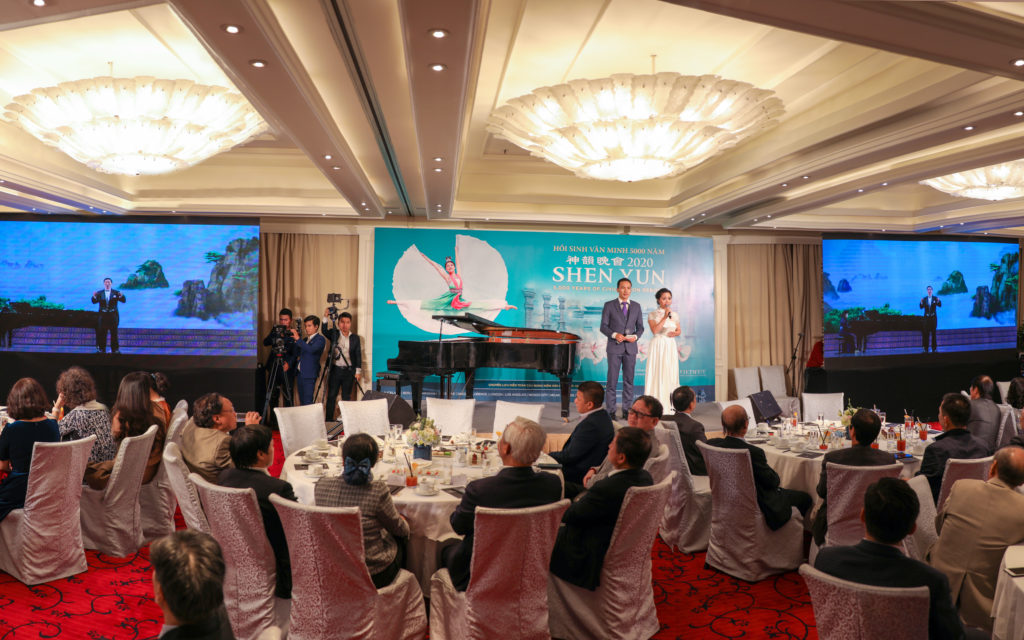
We can also come to the “Four Great Classical Novels” and the works of traditional Chinese culture by enjoying the art of Shen Yun. Shen Yun is a divinely inspired art, the pinnacle of the performing arts in the world. One of Shen Yun’s programmes included the wonderful dance drama “Diao Chan” and the opera “Stratagem”. At Shen Yun we feel as if we are returning to our true selves, whatever our ethnicity and wherever we live on this earth. Many stories, meanings and traditional values of many cultures, as well as classic works, are expressed through Shen Yun’s performing arts, a language without borders.
Prague, Tuesday, 17/01/2023
Author: Dong Quan
|
Shen Yun (Chinese: 神韻 meaning “the beauty of divine beings dancing”). Shen Yun was founded in 2006 by overseas Chinese artists with the mission of reviving 5,000 years of traditional Chinese culture. Shen Yun is a non-profit performing arts company based in the United States that tours internationally, presenting dance performances and symphony concerts. Shen Yun now has eight equally large companies, with about 500 talented artists in total. Every year Shen Yun performs for millions of people and has toured more than 200 cities across Europe, North America, Oceania and Asia. |