The spirit and the way of expression make the fundamental difference between Western ballet and classical Chinese dance.

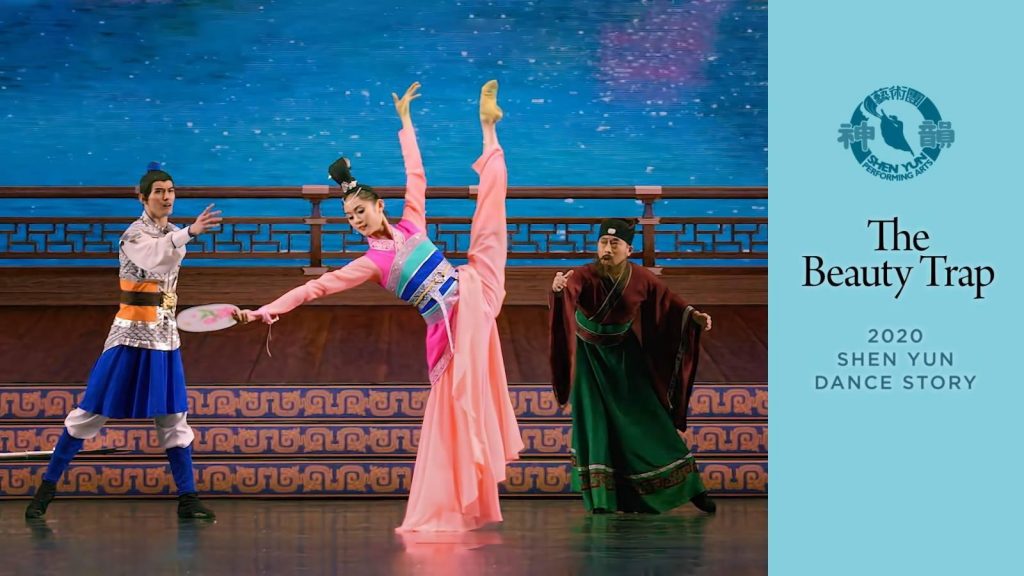
Ballet starts from outer perfection, while the inner quality, or “bearing”, is the root of every movement and expression in classical Chinese dance (Photo: Shen Yun Performing Arts)
One of my first memories of classical dance is watching Mikhail Baryshnikov in “White Nights” spin eleven turns in a row. That moment of pure beauty and heroism left a deep mark on me. Even so, it could not compare with what I witnessed in New York when I saw classical Chinese dance for the first time. I sat still, entranced like everyone around me, enjoying the Shen Yun performance. One dance depicted the legendary Yue Fei, whose mother tattooed on his back the famous words “Serve the country with utmost loyalty”.
As the war drums sounded, the dancers flew through the air, my heart opened and tears came to my eyes – it was so moving and so real, as if I could feel the general’s emotions. As I kept watching, I noticed the core differences between the two art forms, Western ballet and classical Chinese dance – some in the way the body expresses itself, some not.
Two halves of the world
To begin to understand the difference between ballet and classical Chinese dance, we can look at Western and Asian art. The Renaissance, the golden age of the West, produced masterpieces that reached perfection, detail and realism. The Sistine Chapel looks so alive that behind its perfection there may well be a door to Heaven. Ballet is the same: precise and strong, it pursues perfection in outward bodily expression.
A Chinese painting, on the other hand, is made of brushstrokes that are less realistic but say more about inner meaning, symbolising sacred feelings. In the same way, the inner self of the artist is the starting point of classical Chinese dance. This bearing is the root of the dancer’s bodily and emotional expression, often meant to convey the divine through dance.
Ancient arts
Ballet began in Renaissance Italy in the 15th century and was codified a century later by the great patron of the arts, King Louis XIV.
Classical Chinese dance took shape more than 5,000 years ago, rooted in the court dances of ancient times, in folk traditions and, of course, in one of China’s most beloved arts – kung fu. Classical Chinese dance and martial arts could be called two gifted brothers separated long ago.
At the great festivals of the imperial court, generals performed before the emperor, showing the same martial moves they used on the battlefield. For example, a somersault in the air as if dodging a spear, or a “floor-sweeping whirl” as if defending against an attack from all sides.
Neither art form came from the other. Rather, the techniques used in combat became martial arts, while the same moves used for entertainment became dance. The Chinese language reflects this link too: although written differently, the word “wu” in “martial arts” and the word “wu” in “dance” are pronounced exactly the same in Chinese.
Foundations
One of the most visible differences between these two beautiful art forms is the way dancers move across the stage. Ballet dancers dance on pointe – a leg perfectly straight down to the tips of the toes. Classical Chinese dancers, in contrast, glide across the stage with small steps from heel to toe, looking as if they were floating on a cloud.
As each way of stepping calls for its own techniques and features, the complete training system of each art differs accordingly. Ballet training usually begins with footwork and building strength in the legs and core. Only then does it turn to arm technique, pointe work, coordination and advanced techniques (such as the pirouette).
Classical Chinese dance revolves around three core parts – bearing, form, and technical skills, which include highly complex techniques not found in ballet.
Bearing
Bearing, or “yun”, is a quality found only in classical Chinese dance – it is the inner meaning behind every movement. Connected to each breath of the dancer, to their state of mind, moral character, temperament and personality, it is why the Yue Fei dance moved me so strongly. In essence, the spirit decides the expression, so bodily expression is the embodiment of the spirit.
Although the root of the classical Chinese dancer’s movements and expression is the inner self, the whole journey is one, asking the dancer to master both mind and body – a dance is the union of the inner self and the outer realm.
Form
The second core element is form: classical Chinese dance has hundreds of kinds of movements and postures. The turn of the torso, the direction of the gaze and the position of the fingers seem to be separate movements, but in fact they always go together, perfectly coordinated in a circle – the whole body works like a universe or an ecosystem in which every part is in harmony.
Going deeper, although the traditional arts of the West and the East share the same final goal of returning to one’s original home, the two art forms reflect contrasting philosophies about our time on Earth.
The movements of Western ballet follow straight lines, an expression of the Western belief about life – we live, then die – an earthly journey with a clear end. Classical Chinese dance, on the other hand, is round and circular, reflecting an understanding of birth, death and rebirth – reincarnation.
Technical skills
The third core element of classical Chinese dance is technical skills – very difficult techniques such as leaps, flips, turns and tumbling. Many of these physically demanding movements are not found in ballet.
In ballet, for example, turns are performed upright, the body on a perfectly vertical axis. In classical Chinese dance, the upper body leans forward, reaches up or twists back, turning in many directions. In the Chinese art, a dancer can even spin on one leg while holding the other high above the head.
The tumbling techniques of classical Chinese dance are not found in ballet, although they have influenced the West. A few decades ago, Chinese Olympic gymnasts borrowed some tumbling moves from classical Chinese dance for their routines and enchanted the Western world. As a result, these moves have become staples of Western gymnastics.
Despite their differences and distinctive styles, both Western ballet and classical Chinese dance are beautiful and noble art forms that represent the soul of humanity. Come and admire the dancers who strive to preserve the heritage of our planet and inspire us vividly, right here and right now.
Source: The Epoch Times Vietnamese